Category Archives: Uncategorized

Ch 14 Tesla’s Mergers and Acquisitions

In Jay B. Barney’s text Gaining and Sustaining a Competitive Advantage, he describes the valuation of a target firm, and notes that this value depends on the combined value of the two firms as illustrated by the following equation:

P = NPV(A+B) – NPV(A)

He goes on to discuss how a bidding war will ensure efficient pricing of the target firm, but here is where I think we should again point out that the value of the acquisition is derived from the combined value of the two entities; therefore, it is possible (and likely) that different acquiring firms will have differing valuations of a target firm because the sum of their parts may create different revenue opportunities that do not exist with other firm combinations.

Tesla acquired SolarCity in 2016, saying that “the combination would create the world’s first vertically integrated sustainable energy company, taking advantage of the synergies created by linking Tesla’s energy storage with SolarCity’s solar generation.” In 2019, Tesla acquired Maxwell Technologies, a manufacturer of energy storage and power delivery using ultracapacitors. Musk posits that ultracapacitors will be key in advancing battery technology and performance in EVs and that acquiring a company to produce battery technology in house will create cost efficiencies that will reduce the cost of their EVs. These acquisitions are both examples of:

  • a vertical merger, in which a firm acquires a supplier
  • a product extension merger, in which a firm gains access to complementary products, and;
  • a market extension merger, in which a firm gains access complementary markets.

Tesla uses the strategy of vertical integration and narrow diversification in related businesses to create cost efficiencies and value for shareholders, investing in technologies to advance its core business of manufacturing and selling EVs.

Ch 13 Tesla’s Strategic Alliances

In an article for MIT Sloan, Hoang and Rothaermel attribute Tesla’s early success to two key strategic alliances with Daimler AG and Toyota Motor Corp. These kinds of partnerships can increase market share and sales for both companies by improving efficiencies in the overall production of the goods or services. They explain that the Daimler partnership provided much-needed growth capital as well as access to superior engineering and the Toyota partnership provided a manufacturing facility located near its Palo Alto, California headquarters.

Similar to General Motor’s strategy of manufacturing electric powertrain components to sell to other car manufacturers like Honda, part of Tesla’s strategy includes selling electric powertrain components to Daimler and Toyota, a kind of nonequity alliance known as a “supply agreement” between the two firms. And even though Tesla makes its own batteries, it currently also maintains a strategic alliance with Pansonic to produce batteries for its electric vehicles. Recently Tesla and Apple sought to form a strategic alliance to produce the Apple car but were not able to reach agreement on terms.

Ch 12 Tesla’s Agency (Non)Issue

Charles Morris points out in his article that unlike GM and Ford whose CEOs only own miniscule fractions of the companies, Tesla CEO Elon Musk owns 21% of the firm. Morris also points out that Musk won’t receive any compensation until Tesla’s market cap exceeds $100 billion, and will receive the entire package only if Tesla’s valuation reaches $650 billion.

In January 2019, Tesla became the first $100 billion publicly listed U.S. carmaker and in January of 2021, Tesla’s market cap surpassed $800 billion. Not only is Elon Musk’s financial wealth on the line, but his entire reputation and life’s work is tied up in the success or failure of Tesla. It is no surprise then that the valuation targets have been met and this case may be one of the clearest representations of the principle-agency issue.

Ch 11 Tesla’s Limited Diversification Strategy

Tesla pursues what Jay B. Barney, author of Gaining and Sustaining a Competitive Advantage might characterize as a limited diversification strategy, as most of their business activity is vertically integrated and does not diversify into any unrelated lines of business. Under these conditions, management does apply some diversification, but only to the extent that it enhances the core mission of Tesla to transform the auto industry by producing EVs. For instance, Tesla invests significantly in its EV battery business segment, which helps the company maintain its cutting edge battery technology in their EVs. While centered around this main objective to enhance battery performance in their EVs, the company also aims to create battery products for other applications.

Tesla, like most businesses, began as a single-business firm, focused on producing electric vehicles. In May 2015, Musk announced Tesla Energy, expanding the company’s capabilities into a new segment called Energy Generation and Storage. Tesla further invested in solar batteries and battery storage by acquiring Solar City Corporation in 2016. As of 2020, Tesla’s EV batteries are supplied by Panasonic but they are looking to reduce their dependence on them by producing their own batteries.

Ch 10 Tesla’s Vertical Integration Strategy

The number of stages in a product’s or service’s value chain in which a company engages refers to level of the firm’s vertical integration. In a shareholder letter (Q3 2020), Tesla mentioned an “in-sourcing” strategy to achieve rapid growth.CEO Elon Musk described this strategy on a call with investors stating, “Tesla is absurdly vertically integrated compared to other auto companies or basically almost any company. We have a massive amount of internal manufacturing technology that we built ourselves…. It’s like, okay, what are the things we want to make, design a machine that will make that thing, then we make the machine.”

He goes on to point out how this differs from “catalog engineering” in that companies can’t just order the supplies from a catalog and compete with them.

When applying the VRIO framework, we can think of this level of vertical integration as contributing significantly toward the rareness and imitability (or lack thereof) of Tesla products. They have been living on the cutting edge of the EV industry but as more traditional manufacturers who have more experience with larger scaled operations (i.e. Toyota, Volkswagen, GM in the US market) are beginning to produce EVs, it remains to be seen whether this strategy will be enough for Tesla to maintain an edge going forward.

Ch 9 Cooperative Strategies in the Auto Industry

To compete for market share in the EV market, GM, a traditional American auto manufacturer, formed a strategic alliance with Honda to build an EV model for them. The strategic alliance with Honda helps GM manufacture more EVs by having another company selling them in their respective market. By producing more EVs, GM can gain economies of scale in producing their models and advancing battery technology to improve their models.

I believe a strategic alliance between Tesla and Apple would be a beneficial partnership for both companies as Apple has teased investors about entering into the EV market. However, Apple is a tech company and for them to enter the high cost auto industry would decrease their current margins. Instead, Tesla EVs offer a prime opportunity for marketing what Apple already does really well, which is providing streaming music, apps, and other features associated with the iPhone. Integrating these products into Tesla vehicles would present a growth opportunity for both companies.

Post #7 Tesla’s Risky Business (Ch 8)

Stock analysts exhibit a wide dispersion of beliefs in terms of what they think a share of Tesla is worth. This is because of the risk and uncertainty of Tesla’s future cash flows. Proper valuation of a company depends on an analyst’s ability to accurately estimate a firm’s future cash flows. When these future outcomes are uncertain, valuations can vary.

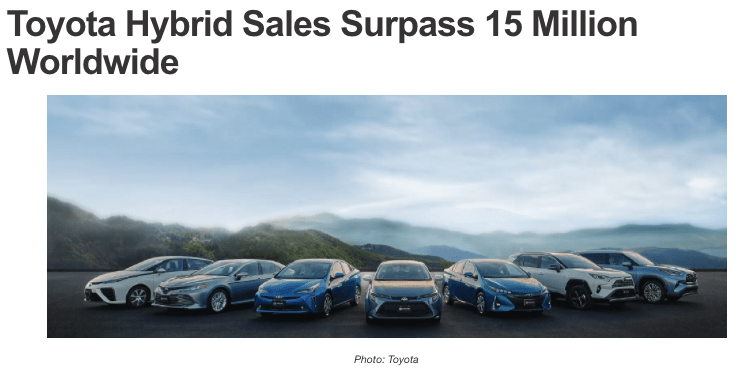
Strategic choices that provide a firm with flexibility and keep its strategic options open are generally considered to be of greater value under conditions of high uncertainty, like those posed in the auto industry. For this reason, I believe Toyota’s approach toward the EV market of providing hybrid models to ease consumers into the transition to an all-EV is appropriate and provides them with a competitive advantage.

Source: https://thenewswheel.com/toyota-hybrid-sales-surpass-15-million-worldwide/

Post #6 Tesla’s Product Differentiation (Ch 7)

The auto industry is cited in the text as an industry in which firms are constantly seeking to differentiate their products. Tesla is focused on product differentiation more than on cost. In fact, the high end nature of specialized tech gadgets makes them appear more valuable to those who can’t afford them, creating demand for when the products become more affordable. A good example of this is Apple in how expensive their products are when first introduced and then become more affordable as newer, higher end gadgets are introduced.

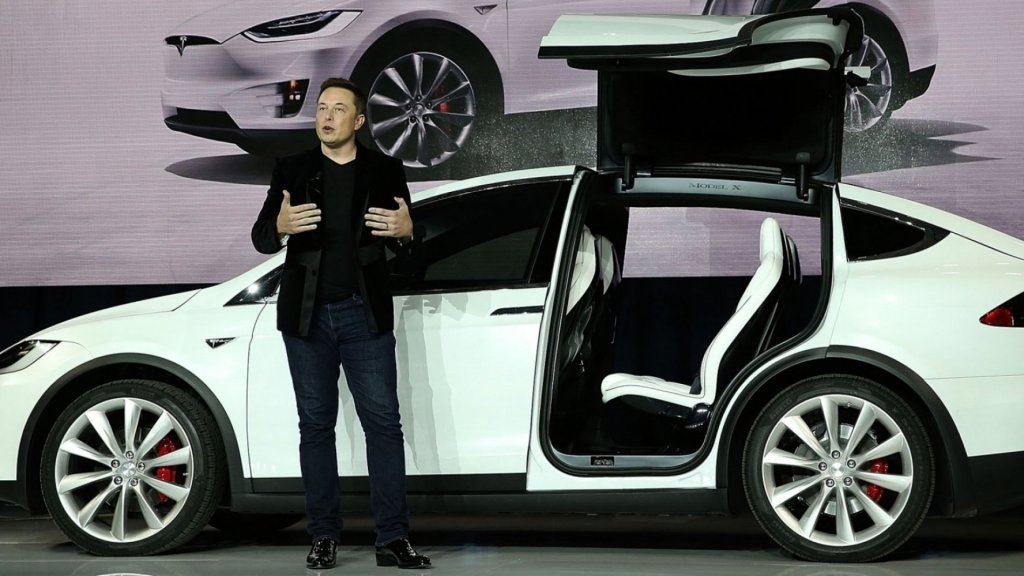
A good example of this is when Elon Musk introduced the Cybertruck, a vehicle design that I don’t foresee a lot of conservative truck drivers adopting anytime soon.

Post #5 Cost Leadership Strategies (Ch 6)

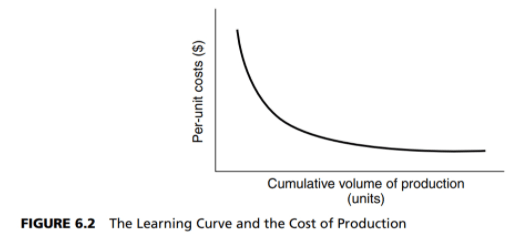
One of the most widely agreed upon sources of cost advantages is a firm’s size, which can produce economies of scale that allow a company to take advantage of cost leadership strategies. Tesla is a much smaller auto company than traditional auto manufacturers such as Toyota and VW, making it difficult for Tesla to take advantage of economies of scale to the extent that these larger companies can. Besides being able to negotiate lower prices from suppliers through bulk orders and other efficiencies due to scale, having a large cumulative amount of volume has been codified as a strategic advantage in the form of the “learning curve.”

While Tesla may be one of the most advanced EV manufacturers, it is by far not the most experienced car manufacturer overall. Toyota and VW have significant advantages in terms of their cumulative years of experience manufacturing cars. Another aspect of cost savings is low-cost access to factors of input. One example might be access to engineering talent needed for a tech firm to innovate, in which case it makes sense that a company like Tesla would be located in Palo Alta, CA, a hub for innovation as well as venture capital.

Post #4 A Resource-Based View of Tesla’s Strengths and Weaknesses (Ch 5)

You can’t think about Tesla without thinking about Elon Musk. In terms of institutional leadership, he is the epitome of the visionary founder/CEO stereotype. A traditional perspective of firm competencies places heavy focus on the top managers to try to ascertain what special characteristics they may have that make their firms outperform. However, the research on CEO talent is mixed and there are limits to this approach, namely, that it ignores many other firm strengths that may be more important. The cultural criticism of Elon Musk through memes making fun of his personae as an ego out of touch billionaire who thinks he knows better than everyone else is an apt criticism of this line of theory.

When thinking about a company’s competitive strengths, institutional leadership is one type of distinctive competency. But while vision-setting is very important, and founders can have an incredible impact on defining that vision, it takes more than a visionary founder to run a truly incredible operation. This requires talented managers at all levels of the firm and more importantly, a team approach that leverages strengths while minimizing weaknesses.

I learned quite a bit about this approach to determining distinctive competencies when I was working as an analyst of private investments. Private investments include venture capital investments in start-up firms. When analyzing the strength of a start-up firm, it is all about the human resources, talent, and experience at the table. And when choosing fund managers to invest with, a major determinant is the strength of their team. Do they have diverse perspectives at the table to inhibit blind spots? What value does the sum of their efforts have beyond the individual components?

Ricardian economics focuses on unique and inelastic qualities firms possess that give them competitive advantage. For instance, these elite teams are likely fewer and more unique than finding a single top manager who is a good leader. Managers who are visionary institutional leaders may be rare, but then by definition visionary leaders who can also work in teams are even more rare. This is certainly something Elon Musk might consider in his managerial approach to Tesla.